React vs Vue vs Angular: A 2026 Comparison
Table of Contents
Overview of Frameworks
React, Vue, and Angular remain the most prominent JavaScript frameworks in 2026. React 19’s concurrent features, Vue 3.5+ refinements, and Angular’s continued enterprise cadence mean teams are choosing as much on DX and hiring as on raw benchmarks—so understanding strengths, weaknesses, and real-world usage is essential for any long-term stack decision.
2025 Stats Overview


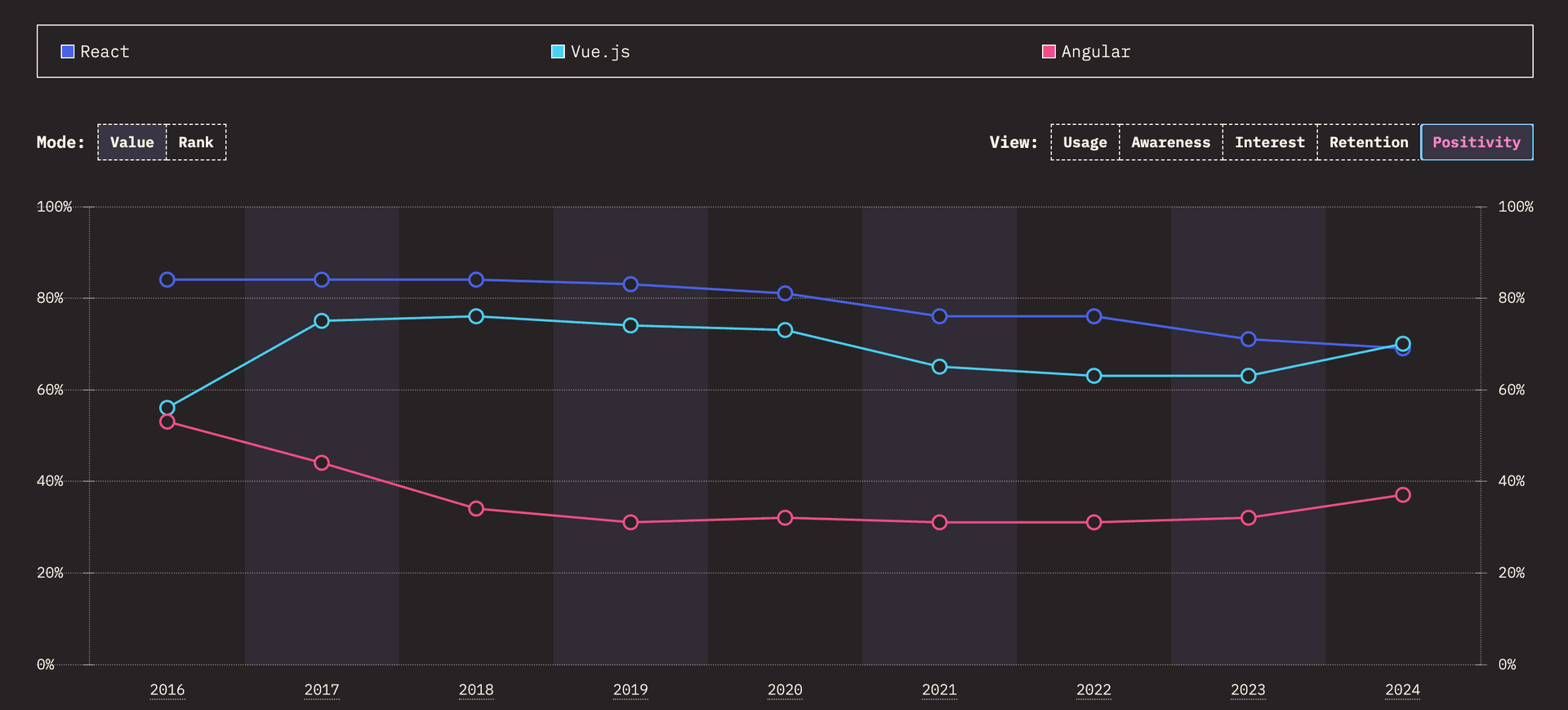
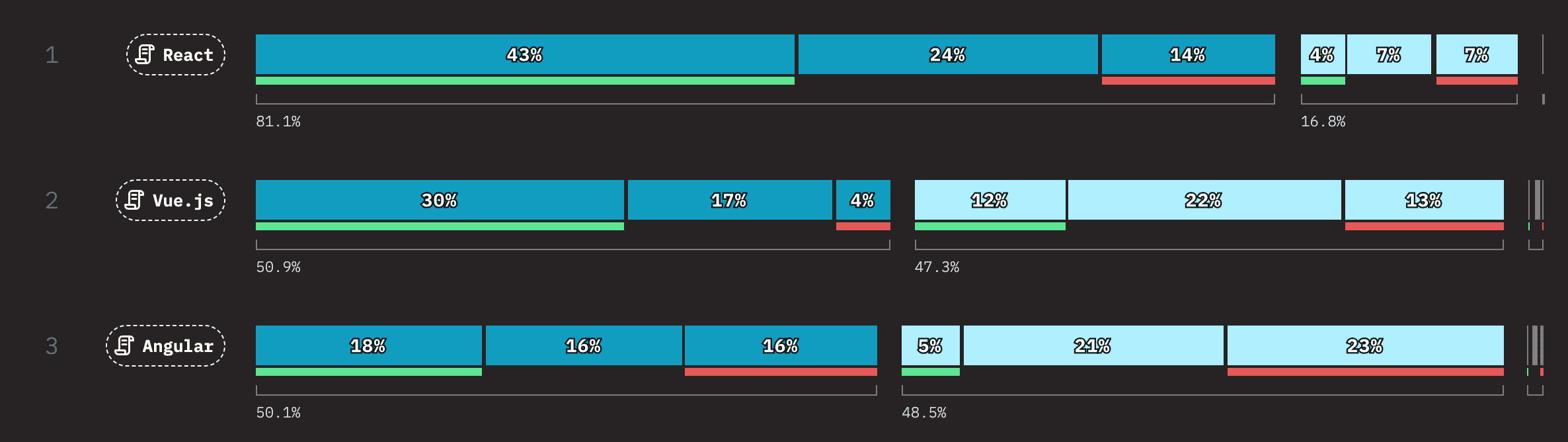
Snapshot for 2026: the figures below are representative of recent State of JavaScript–style survey dimensions (awareness, interest, usage, retention, positivity). Exact percentages move year to year—use them to compare relative positioning, not as guarantees.
React: Awareness: 99% | Interest: 34% | Usage: 82% | Retention: 75% | Positivity: 47%
Vue.js: Awareness: 99% | Interest: 48% | Usage: 51% | Retention: 87% | Positivity: 42%
Angular: Awareness: 99% | Interest: 17% | Usage: 50% | Retention: 54% | Positivity: 23%
Key insight for 2026: React still leads raw usage; Vue keeps standout retention; Angular remains the structured choice for large orgs even where “hype” scores stay modest.
Architecture and Design
Each framework approaches application design differently in 2026:
- React: A view-layer library with flexibility in choosing tools for routing, state, and more—you compose the stack (e.g. React Router, TanStack Query, Next.js) as needed.
- Vue: A progressive framework — start small or scale up. Vue 3’s Composition API and Vite remain central to modern Vue DX.
- Angular: A full-featured, opinionated framework with signals, standalone APIs, and the CLI—ideal for structured, large-scale apps.
Learning Curve
How quickly developers can onboard:
- React: Moderate learning curve. JSX is initially unfamiliar, and the ecosystem’s flexibility can be overwhelming for beginners.
- Vue: Easiest to learn. Clean structure and single-file components make it ideal for newcomers.
- Angular: Steep learning curve. Requires TypeScript knowledge, familiarity with RxJS, and understanding CLI and modules.
Performance Comparison
All three are fast for most use cases, but here's how they differ:
- React: Virtual DOM enables quick updates, especially for dynamic UIs.
- Vue: Also uses a Virtual DOM, but its optimized reactivity system can offer performance benefits in some scenarios.
- Angular: Larger in size and uses real DOM by default. However, AOT (Ahead-of-Time) compilation helps improve speed.
Ecosystem and Tooling
Tooling determines the developer experience in 2026:
- React: Extremely modular. Pair with Next.js (App Router) for SSR/RSC, Tailwind or MUI for UI, and data libraries like TanStack Query or Apollo.
- Vue: Vite is the default bundler; Nuxt for full-stack and SSR. Vue DevTools remain strong for debugging.
- Angular: The CLI, RxJS, HTTP client, forms, and testing are still first-class—ideal for large, complex apps.
Real-world Use Cases
Where are these frameworks being used in 2026?
- React: Facebook, Instagram, Airbnb, Uber, WhatsApp Web.
- Vue: Alibaba, Xiaomi, 9GAG, GitLab (partially).
- Angular: Google, Microsoft Office Web, Deutsche Bank, PayPal.
Trends: React still dominates startups and product teams. Angular remains strong in regulated and large-scale enterprise. Vue continues to win small-to-mid companies, especially in Asia.
Community and Job Market
A strong community means better learning resources and job opportunities:
- React: Most popular globally. Massive community and extensive job listings.
- Vue: Rapid growth and a passionate developer base. Popular on GitHub with many community-built plugins.
- Angular: Reliable in enterprise settings. Many job roles require Angular for legacy and structured systems.
Usage at Work
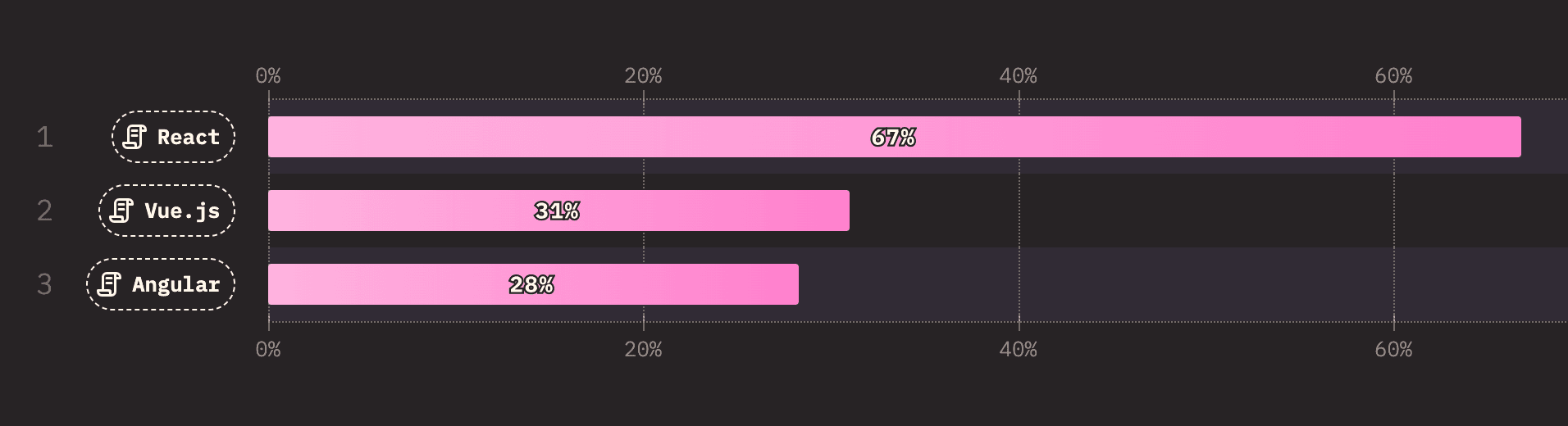
React: Used by roughly two-thirds of professionals in recent surveys — it remains the top framework in production.
Vue: A large minority use it at work, especially in startups and lightweight apps.
Angular: Substantial workplace usage, concentrated in larger organizations.
Takeaway for 2026: React is still the default hire for many teams; Vue wins satisfaction and retention in many cohorts; Angular stays the structured enterprise pick.
Conclusion
Every framework shines in different areas:
- React: Great for flexibility, scalability, and talent availability. But be mindful of ecosystem fatigue.
- Vue: Combines simplicity with power. High satisfaction and retention make it a balanced choice.
- Angular: Ideal for structured, large-scale enterprise apps. Comes ready with everything but may be heavier to manage.
In the end, base your decision on your team's experience, project scale, and long-term maintenance goals.